Calculates the Neighbouring Grey Level Dependence Features. More...
#include <mitkGIFNeighbouringGreyLevelDependenceFeatures.h>
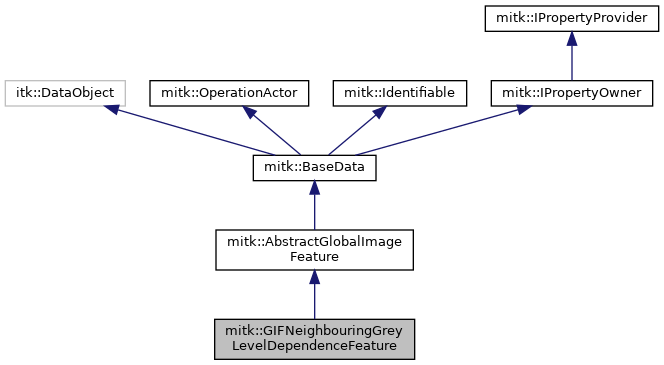
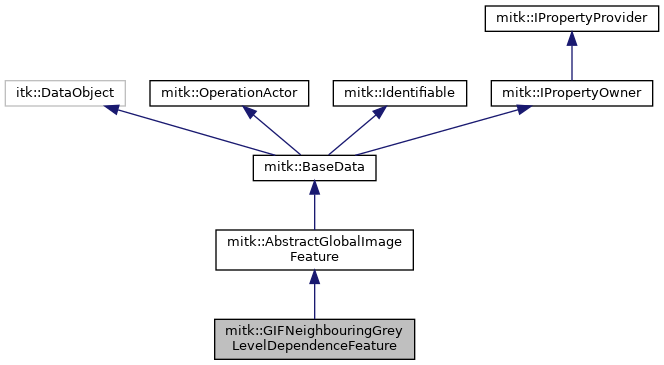
Public Member Functions | |
| mitkClassMacro (GIFNeighbouringGreyLevelDependenceFeature, AbstractGlobalImageFeature) | |
| Pointer | Clone () const |
| GIFNeighbouringGreyLevelDependenceFeature () | |
| FeatureListType | CalculateFeatures (const Image *image, const Image *mask, const Image *maskNoNAN) override |
| Calculate neighbouring grey level dependence features for the given image and mask. More... | |
| virtual std::vector< double > | GetRanges () const |
| Get the distance ranges for neighbourhood computation. More... | |
| void | SetRanges (std::vector< double > ranges) |
| Set multiple distance ranges for neighbourhood computation. More... | |
| void | SetRange (double range) |
| Set a single distance range for neighbourhood computation. More... | |
| virtual int | GetAlpha () const |
| Get the alpha coarseness parameter for dependence counting. More... | |
| virtual void | SetAlpha (int _arg) |
| Set the alpha coarseness parameter for dependence counting. More... | |
| void | AddArguments (mitkCommandLineParser &parser) const override |
| Add command line arguments for configuring this feature class. More... | |
 Public Member Functions inherited from mitk::AbstractGlobalImageFeature Public Member Functions inherited from mitk::AbstractGlobalImageFeature | |
| mitkClassMacro (AbstractGlobalImageFeature, BaseData) | |
| FeatureListType | CalculateFeatures (const Image *image, const Image *mask) |
| Calculates the feature of this abstract interface. Does not necessarily considers the parameter settings. More... | |
| FeatureListType | CalculateFeaturesSlicewise (const Image::Pointer &image, const Image::Pointer &mask, int sliceID) |
| Calculates the given feature Slice-wise. Might not be available for an individual filter! More... | |
| virtual void | CalculateAndAppendFeaturesSliceWise (const Image::Pointer &image, const Image::Pointer &mask, int sliceID, FeatureListType &featureList, bool checkParameterActivation=true) |
| Calculates the feature of this abstract interface. Does not necessarily considers the parameter settings. More... | |
| void | CalculateAndAppendFeatures (const Image *image, const Image *mask, const Image *maskNoNaN, FeatureListType &featureList, bool checkParameterActivation=true) |
| Calculates the feature of this abstract interface. Does not necessarily considers the parameter settings. More... | |
| virtual void | SetPrefix (std::string _arg) |
| Set the prefix prepended to command line option names. More... | |
| virtual void | SetShortName (std::string _arg) |
| Set the short name used in option keys and feature names. More... | |
| virtual void | SetLongName (std::string _arg) |
| Set the long (human-readable) name of this feature class. More... | |
| virtual void | SetFeatureClassName (std::string _arg) |
| Set the feature class name used in FeatureID. More... | |
| virtual void | SetDirection (int _arg) |
| Set the direction index for directional feature computation. More... | |
| void | SetParameters (ParametersType param) |
| Set the parameter map and reconfigure the instance accordingly. More... | |
| virtual std::string | GetPrefix () const |
| Get the command line option prefix. More... | |
| virtual std::string | GetShortName () const |
| Get the short name of this feature class. More... | |
| virtual std::string | GetLongName () const |
| Get the long name of this feature class. More... | |
| virtual std::string | GetFeatureClassName () const |
| Get the feature class name. More... | |
| virtual ParametersType | GetParameters () const |
| Get the current parameter map. More... | |
| virtual IntensityQuantifier::Pointer | GetQuantifier () |
| Get the IntensityQuantifier used for histogram-based feature computation. More... | |
| virtual int | GetDirection () const |
| Get the direction index. More... | |
| virtual void | SetMinimumIntensity (double _arg) |
| Set the minimum intensity for histogram initialization. More... | |
| virtual void | SetUseMinimumIntensity (bool _arg) |
| Set whether to use the explicit minimum intensity. More... | |
| virtual void | SetMaximumIntensity (double _arg) |
| Set the maximum intensity for histogram initialization. More... | |
| virtual void | SetUseMaximumIntensity (bool _arg) |
| Set whether to use the explicit maximum intensity. More... | |
| virtual double | GetMinimumIntensity () const |
| Get the minimum intensity for histogram initialization. More... | |
| virtual bool | GetUseMinimumIntensity () const |
| Get whether the explicit minimum intensity is used. More... | |
| virtual double | GetMaximumIntensity () const |
| Get the maximum intensity for histogram initialization. More... | |
| virtual bool | GetUseMaximumIntensity () const |
| Get whether the explicit maximum intensity is used. More... | |
| virtual void | SetBinsize (double _arg) |
| Set the histogram bin size. More... | |
| virtual void | SetUseBinsize (bool _arg) |
| Set whether to use the explicit bin size for histogram initialization. More... | |
| virtual double | GetBinsize () const |
| Get the histogram bin size. More... | |
| virtual bool | GetUseBinsize () const |
| Get whether the explicit bin size is used. More... | |
| virtual void | SetMorphMask (mitk::Image::Pointer _arg) |
| Set the morphological mask image used by some feature classes. More... | |
| virtual mitk::Image::Pointer | GetMorphMask () const |
| Get the morphological mask image. More... | |
| virtual void | SetBins (int _arg) |
| Set the number of histogram bins. More... | |
| virtual void | SetUseBins (bool _arg) |
| Set whether to use the explicit bin count for histogram initialization. More... | |
| virtual bool | GetUseBins () const |
| Get whether the explicit bin count is used. More... | |
| virtual int | GetBins () const |
| Get the number of histogram bins. More... | |
| virtual void | SetIgnoreMask (bool _arg) |
| Set whether to ignore the mask when computing histogram ranges. More... | |
| virtual bool | GetIgnoreMask () const |
| Get whether the mask is ignored for histogram range computation. More... | |
| virtual void | SetEncodeParametersInFeaturePrefix (bool _arg) |
| Set whether to encode parameter values in the feature name prefix. More... | |
| virtual bool | GetEncodeParametersInFeaturePrefix () const |
| Get whether parameter values are encoded in the feature name prefix. More... | |
| virtual void | EncodeParametersInFeaturePrefixOn () |
| Toggle encoding of parameter values in the feature name prefix. More... | |
| virtual void | EncodeParametersInFeaturePrefixOff () |
| std::string | GetOptionPrefix () const |
| Build the full option prefix string for command line parameters. More... | |
| void | SetRequestedRegionToLargestPossibleRegion () override |
| Set the RequestedRegion to the LargestPossibleRegion. More... | |
| bool | RequestedRegionIsOutsideOfTheBufferedRegion () override |
| Determine whether the RequestedRegion is outside of the BufferedRegion. More... | |
| bool | VerifyRequestedRegion () override |
| Verify that the RequestedRegion is within the LargestPossibleRegion. More... | |
| void | SetRequestedRegion (const itk::DataObject *) override |
| Set the requested region from this data object to match the requested region of the data object passed in as a parameter. More... | |
| bool | IsEmpty () const override |
| Check whether the object contains data at any time step. More... | |
| Public Member Functions inherited from mitk::BaseData | |
| mitkClassMacroItkParent (BaseData, itk::DataObject) | |
| BaseProperty::ConstPointer | GetConstProperty (const std::string &propertyKey, const std::string &contextName="", bool fallBackOnDefaultContext=true) const override |
| Get a const property by its key. More... | |
| std::vector< std::string > | GetPropertyKeys (const std::string &contextName="", bool includeDefaultContext=false) const override |
| Get all property keys stored in the property list. More... | |
| std::vector< std::string > | GetPropertyContextNames () const override |
| Get the names of all property contexts. More... | |
| BaseProperty * | GetNonConstProperty (const std::string &propertyKey, const std::string &contextName="", bool fallBackOnDefaultContext=true) override |
| Get a non-const property by its key. More... | |
| void | SetProperty (const std::string &propertyKey, BaseProperty *property, const std::string &contextName="", bool fallBackOnDefaultContext=false) override |
| Set a property in the property list. More... | |
| void | RemoveProperty (const std::string &propertyKey, const std::string &contextName="", bool fallBackOnDefaultContext=false) override |
| Remove a property from the property list. More... | |
| const mitk::TimeGeometry * | GetTimeGeometry () const |
| Return the TimeGeometry of the data as const pointer. More... | |
| mitk::TimeGeometry * | GetTimeGeometry () |
| Return the TimeGeometry of the data as non-const pointer. More... | |
| const mitk::TimeGeometry * | GetUpdatedTimeGeometry () |
| Return the TimeGeometry of the data after ensuring it is up-to-date. More... | |
| virtual void | Expand (unsigned int timeSteps) |
| Expand the TimeGeometry to a number of time steps. More... | |
| const mitk::BaseGeometry * | GetUpdatedGeometry (int t=0) |
| Return the BaseGeometry of the data at time step t after ensuring it is up-to-date. More... | |
| mitk::BaseGeometry * | GetGeometry (int t=0) const |
| Return the BaseGeometry of the data at time step t as a non-const pointer. More... | |
| void | UpdateOutputInformation () override |
| Update the information for this BaseData so that it can be used as an output of a BaseProcess. More... | |
| void | CopyInformation (const itk::DataObject *data) override |
| Copy information from the specified data set. More... | |
| virtual bool | IsInitialized () const |
| Check whether the data has been initialized. More... | |
| virtual void | Clear () |
| Reset the data object by calling ClearData() and InitializeEmpty(). More... | |
| virtual bool | IsEmptyTimeStep (unsigned int t) const |
| Check whether the object contains data at the specified time step. More... | |
| void | ExecuteOperation (Operation *operation) override |
| Execute an operation on this data object. More... | |
| virtual void | SetGeometry (BaseGeometry *aGeometry3D) |
| Set the BaseGeometry of the data, which will be referenced (not copied!). More... | |
| virtual void | SetTimeGeometry (TimeGeometry *geometry) |
| Set the TimeGeometry of the data, which will be referenced (not copied!). More... | |
| virtual void | SetClonedGeometry (const BaseGeometry *aGeometry3D) |
| Set a clone of the provided geometry as the BaseGeometry of the data. More... | |
| virtual void | SetClonedTimeGeometry (const TimeGeometry *geometry) |
| Set a clone of the provided TimeGeometry as the TimeGeometry of the data. More... | |
| virtual void | SetClonedGeometry (const BaseGeometry *aGeometry3D, unsigned int time) |
| Set a clone of the provided geometry as the BaseGeometry of a given time step. More... | |
| mitk::PropertyList::Pointer | GetPropertyList () const |
| Get the data's property list. More... | |
| void | SetPropertyList (PropertyList *propertyList) |
| Set the data's property list, replacing the existing one. More... | |
| mitk::BaseProperty::Pointer | GetProperty (const char *propertyKey) const |
| Get a property by its key from the PropertyList. More... | |
| void | SetProperty (const char *propertyKey, BaseProperty *property) |
| Set a property in the PropertyList. More... | |
| virtual void | SetOrigin (const Point3D &origin) |
| Convenience method for setting the origin of the BaseGeometry instances of all time steps. More... | |
| itk::SmartPointer< mitk::BaseDataSource > | GetSource () const |
| Get the process object that generated this data object. More... | |
| unsigned int | GetTimeSteps () const |
| Get the number of time steps from the TimeGeometry. More... | |
| itk::ModifiedTimeType | GetMTime () const override |
| Get the modification time of this data object or its geometry, whichever was modified most recently. More... | |
| void | Graft (const DataObject *) override |
| Graft data and information from another data object. More... | |
| Public Member Functions inherited from mitk::OperationActor | |
| itkTypeMacroNoParent (OperationActor) virtual ~OperationActor() | |
| Public Member Functions inherited from mitk::Identifiable | |
| Identifiable () | |
| Default constructor. Generates a new random UID. More... | |
| Identifiable (const UIDType &uid) | |
| Construct with a pre-existing UID. More... | |
| Identifiable (const Identifiable &)=delete | |
| Copy construction is deleted to prevent UID duplication. More... | |
| Identifiable (Identifiable &&) noexcept | |
| Move constructor. Transfers ownership of the UID. More... | |
| virtual | ~Identifiable () |
| Virtual destructor. More... | |
| Identifiable & | operator= (const Identifiable &)=delete |
| Copy assignment is deleted to prevent UID duplication. More... | |
| Identifiable & | operator= (Identifiable &&other) noexcept |
| Move assignment operator. Transfers ownership of the UID. More... | |
| virtual UIDType | GetUID () const |
| Get the unique identifier of this object. More... | |
| UIDType | GetRuntimeUID () const noexcept |
| Get a runtime-unique ID for this object instance. More... | |
| Public Member Functions inherited from mitk::IPropertyOwner | |
| ~IPropertyOwner () override | |
| virtual bool | PropertyIsOwned (const std::string &propertyKey, const std::string &contextName="", bool fallBackOnDefaultContext=true) const |
| Checks if a certain property exists. More... | |
| Public Member Functions inherited from mitk::IPropertyProvider | |
| virtual | ~IPropertyProvider () |
| Virtual destructor. More... | |
Static Public Member Functions | |
| static Pointer | New () |
| Static Public Member Functions inherited from mitk::AbstractGlobalImageFeature | |
| static std::string | GenerateLegacyFeatureNameWOEncoding (const FeatureID &id) |
Protected Member Functions | |
| std::string | GenerateLegacyFeatureEncoding (const FeatureID &id) const override |
| FeatureListType | DoCalculateFeatures (const Image *image, const Image *mask) override |
| void | ConfigureSettingsByParameters (const ParametersType ¶meters) override |
| Protected Member Functions inherited from mitk::AbstractGlobalImageFeature | |
| std::vector< double > | SplitDouble (std::string str, char delimiter) |
| void | AddQuantifierArguments (mitkCommandLineParser &parser) const |
| void | ConfigureQuantifierSettingsByParameters () |
| void | InitializeQuantifier (const Image *image, const Image *mask, unsigned int defaultBins=256) |
| std::string | QuantifierParameterString () const |
| FeatureID | CreateTemplateFeatureID (std::string settingsSuffix="", FeatureID::ParametersType additionalParams={}) |
| virtual std::string | GenerateLegacyFeatureName (const FeatureID &id) const |
| virtual std::string | GenerateLegacyFeatureNamePart (const FeatureID &id) const |
| Protected Member Functions inherited from mitk::BaseData | |
| BaseData () | |
| BaseData (const BaseData &other) | |
| ~BaseData () override | |
| virtual void | InitializeTimeGeometry (unsigned int timeSteps=1) |
| Initialize the TimeGeometry for a number of time steps. The TimeGeometry is initialized empty and evenly timed. In many cases it will be necessary to overwrite this in sub-classes. More... | |
| virtual void | ClearData () |
| reset to non-initialized state, release memory More... | |
| virtual void | InitializeEmpty () |
| Pure virtual; Must be used in subclasses to get a data object to a valid state. Should at least create one empty object and call Superclass::InitializeTimeGeometry() to ensure an existing valid geometry. More... | |
| void | PrintSelf (std::ostream &os, itk::Indent indent) const override |
| Protected Member Functions inherited from mitk::Identifiable | |
| virtual void | SetUID (const UIDType &uid) |
Additional Inherited Members | |
| Public Types inherited from mitk::AbstractGlobalImageFeature | |
| typedef std::vector< std::pair< FeatureID, double > > | FeatureListType |
| using | ParametersType = FeatureID::ParametersType |
| Public Types inherited from mitk::Identifiable | |
| using | UIDType = std::string |
| Type alias for unique identifiers. More... | |
| Protected Attributes inherited from mitk::BaseData | |
| bool | m_LastRequestedRegionWasOutsideOfTheBufferedRegion |
| unsigned int | m_SourceOutputIndexDuplicate |
| bool | m_Initialized |
Detailed Description
Calculates the Neighbouring Grey Level Dependence Features.
The Neighbouring Grey Level Dependence Features were proposed by Sun and Wee (1983) and capture the coarsness of the image texture. They are rotational invariant.
The features are calculated on a matrix \( m \). To obtain the matrix, a neighbourhood around each feature is calculated and the number of voxels within the neighbourhood that are greater than the center voxel plus \( \alpha \) is counted. This is called the number of dependence voxels. The matrix gives the number of voxels with an intensity \( x \) and \( d \) dependence neighbourhood voxels.
The image is quantified prior to the calculation of the features. This reduces the number of available intensity values. Instead of using the pure intensity value, the features are calculated using the number of the bins as intensity value \( x_i \). The parameter of the quantification of the image can be controlled using the general binning parameters as defined in AbstractGlobalImageFeature.
By default, the calculation is based on a 26 neighbourhood for 3D and a 8 neighbourhood in 2D. It is further possible to exclude directions from the calculation, e.g. calculating the feature in 2D, even if a 3D image is passed. This is controlled by determine the dimensionality of the neighbourhood using direction-related commands as described in AbstractGlobalImageFeature.
In addition to this, the size of the neighbourhood can be controlled by setting the parameter ngld::range. By default it is one. To pass more than one range, separate the ranges with a semicolon. E.g. 1;2;3 would calculate the features for the ranges 1, 2, and 3.
This feature calculator is activated by the option -neighbouring-grey-level-dependence or -ngld.
The features are calculated based on a mask. It is assumed that the mask is a unsigned short image. All voxels with a value greater 0 are treated as masked.
Several values are defined for the definition of the features. \( N_v \) is the number of masked voxels, \(N_s \) is the number of neighbourhoods, \( m_{x,\cdot} = \sum_d m{x,d} \) is the number of neighbourhoods with a given intensity value, and likewise \( m_{\cdot, d} = \sum_x m{x,d} \) is the number of neighbourhoods with a given number of dependence features:
- Neighbouring Grey Level Dependence::Low Dependence Emphasis:
\[ \textup{Low dependence emphasis}= \frac{1}{N_s} \sum_d { \frac{m_{\cdot, d}}{d^2} } \]
- Neighbouring Grey Level Dependence::High Dependence Emphasis:
\[ \textup{High dependence emphasis}= \frac{1}{N_s} \sum_d { m_{\cdot, d} d^2} \]
- Neighbouring Grey Level Dependence::Low Grey Level Count Emphasis:
\[ \textup{Low grey level count emphasis}= \frac{1}{N_s} \sum_x { \frac{m_{x,\cdot}}{x^2} } \]
- Neighbouring Grey Level Dependence::High Grey Level Count Emphasis:
\[ \textup{High grey level count emphasis}= \frac{1}{N_s} \sum_x { m_{x,\cdot} x^2} \]
- Neighbouring Grey Level Dependence::Low Dependence Low Grey Level Emphasis:
\[ \textup{Low Dependence Low Grey Level Emphasis}= \frac{1}{N_s} \sum_x \sum_d { \frac{m_{x,d}}{x^2 d^2} } \]
- Neighbouring Grey Level Dependence::Low Dependence High Grey Level Emphasis:
\[ \textup{Low dependence high grey level emphasis}= \frac{1}{N_s} \sum_x \sum_d { \frac{x^2 m_{x,d}}{d^2} } \]
- Neighbouring Grey Level Dependence::High Dependence Low Grey Level Emphasis:
\[ \textup{High Dependence Low Grey Level Emphasis}= \frac{1}{N_s} \sum_x \sum_d { \frac{d^2 m_{x,d}}{x^2} } \]
- Neighbouring Grey Level Dependence::High Dependence High Grey Level Emphasis:
\[ \textup{High dependence high grey level emphasis}= \frac{1}{N_s} \sum_x \sum_d { x^2 d^2 m_{x,d} } \]
- Neighbouring Grey Level Dependence::Grey level nonuniformity:
\[ \textup{Grey level nonuniformity}= \frac{1}{N_s} \sum_x m_{x,\cdot}^2 \]
- Neighbouring Grey Level Dependence::Grey level nonuniformity normalized:
\[ \textup{Grey level nonuniformity normalized}= \frac{1}{N_s^2} \sum_x m_{x,\cdot}^2 \]
- Neighbouring Grey Level Dependence::Dependence Count Nonuniformity:
\[ \textup{Dependence count nonuniformity}= \frac{1}{N_s} \sum_d m_{\cdot, d}^2 \]
- Neighbouring Grey Level Dependence::Dependence Count Nonuniformity Normalized:
\[ \textup{Dependence count nonuniformity normalized}= \frac{1}{N_s^2} \sum_d m_{\cdot, d}^2 \]
- Neighbouring Grey Level Dependence::DEpendence Count Percentage THe number of realized neighbourhoods relativ to the theoretical maximum of realized neighbourhoods. This feature is always one for this implementation as partial neighbourhoods are still considered.
- Neighbouring Grey Level Dependence::Grey Level Mean: The mean value of all grey level.
\[ \textup{Grey Level Mean} = \mu_x = \frac{1}{N_s} \sum_x x m_{x,\cdot} \]
- Neighbouring Grey Level Dependence::Grey Level Variance:
\[ \textup{Grey level variance} = \frac{1}{N_s} \sum_x (x -mu_x)^2 m_{x, \cdot} \]
- Neighbouring Grey Level Dependence::Dependence Count Mean: The mean value of all dependence counts.
\[ \textup{Dependence count mean} = \mu_d = \frac{1}{N_s} \sum_d d m_{\cdot,d} \]
- Neighbouring Grey Level Dependence::Dependence Count Variance:
\[ \textup{Dependence count variance} = \frac{1}{N_s} \sum_d (d -mu_d)^2 m_{\cdot, d} \]
- Neighbouring Grey Level Dependence::Dependence Count Entropy: This feature would be equivalent with the Grey Level Entropy, which is therefore not included. It is based on the likelihood for a given intensity- size combination \( p_{x,d} = \frac{m_{x,d}}{N_s} \). :
\[ \textup{Dependence count entropy} = \sum_x \sum_d p_{x,d} \textup{log}_2 \left( p_{x,d} \right) \]
- Neighbouring Grey Level Dependence::Dependence Count Energy: This feature would be equivalent with the Grey Level Energy, which is therefore not included. It is based on the likelihood for a given intensity- size combination \( p_{x,d} = \frac{m_{x,d}}{N_s} \). :
\[ \textup{Dependence count energy} = \sum_x \sum_d p_{x,d}^2 \]
- Neighbouring Grey Level Dependence::Expected Neighbourhood Size: The expected size of a full neighbourhood. It depends on the dimension of the area that is looked at.
- Neighbouring Grey Level Dependence::Average Neighbourhood Size: The feature calculation allows to consider partially masked neighbourhoods. Due to that, some neighbourhoods might be smaller. This feature gives not the theoretical neighbourhood size but the average realized neighbourhood sizes.
- Neighbouring Grey Level Dependence::Average Incomplete Neighbourhood Size: Gives the average size of all neighbourhoods that are not complete.
- Neighbouring Grey Level Dependence::Percentage of complete Neighbourhoods: Gives the percentage of all complete neighbourhoods from all realized neighbourhoods.
- Neighbouring Grey Level Dependence::Percentage of Dependence Neighbour Voxels: Gives the percentage of voxels in all neighbourhoods compared to the expected number of voxels.
Definition at line 116 of file mitkGIFNeighbouringGreyLevelDependenceFeatures.h.
Constructor & Destructor Documentation
◆ GIFNeighbouringGreyLevelDependenceFeature()
| mitk::GIFNeighbouringGreyLevelDependenceFeature::GIFNeighbouringGreyLevelDependenceFeature | ( | ) |
Member Function Documentation
◆ AddArguments()
|
overridevirtual |
Add command line arguments for configuring this feature class.
- Parameters
-
[in,out] parser The command line parser to add arguments to.
Implements mitk::AbstractGlobalImageFeature.
◆ CalculateFeatures()
|
overridevirtual |
Calculate neighbouring grey level dependence features for the given image and mask.
- Parameters
-
[in] image The input intensity image. [in] mask The binary mask defining the region of interest. [in] maskNoNAN The mask with NaN voxels excluded.
- Returns
- A list of computed feature name-value pairs.
Implements mitk::AbstractGlobalImageFeature.
◆ Clone()
| Pointer mitk::GIFNeighbouringGreyLevelDependenceFeature::Clone | ( | ) | const |
◆ ConfigureSettingsByParameters()
|
overrideprotectedvirtual |
Ensures that the instance is configured according to the information given in the passed parameters. This method will be called by SetParameters(...) after ConfigureQuantifierSettingsByParameters() was called.
Reimplemented from mitk::AbstractGlobalImageFeature.
◆ DoCalculateFeatures()
|
overrideprotectedvirtual |
Implements mitk::AbstractGlobalImageFeature.
◆ GenerateLegacyFeatureEncoding()
|
overrideprotectedvirtual |
Reimplemented from mitk::AbstractGlobalImageFeature.
◆ GetAlpha()
|
virtual |
Get the alpha coarseness parameter for dependence counting.
◆ GetRanges()
|
virtual |
Get the distance ranges for neighbourhood computation.
◆ mitkClassMacro()
| mitk::GIFNeighbouringGreyLevelDependenceFeature::mitkClassMacro | ( | GIFNeighbouringGreyLevelDependenceFeature | , |
| AbstractGlobalImageFeature | |||
| ) |
◆ New()
|
static |
◆ SetAlpha()
|
virtual |
Set the alpha coarseness parameter for dependence counting.
◆ SetRange()
| void mitk::GIFNeighbouringGreyLevelDependenceFeature::SetRange | ( | double | range | ) |
Set a single distance range for neighbourhood computation.
- Parameters
-
[in] range The neighbourhood distance (default: 1).
◆ SetRanges()
| void mitk::GIFNeighbouringGreyLevelDependenceFeature::SetRanges | ( | std::vector< double > | ranges | ) |
Set multiple distance ranges for neighbourhood computation.
- Parameters
-
[in] ranges Vector of neighbourhood distances.
The documentation for this class was generated from the following file: