Base class of identifiable objects. More...
#include <mitkIdentifiable.h>
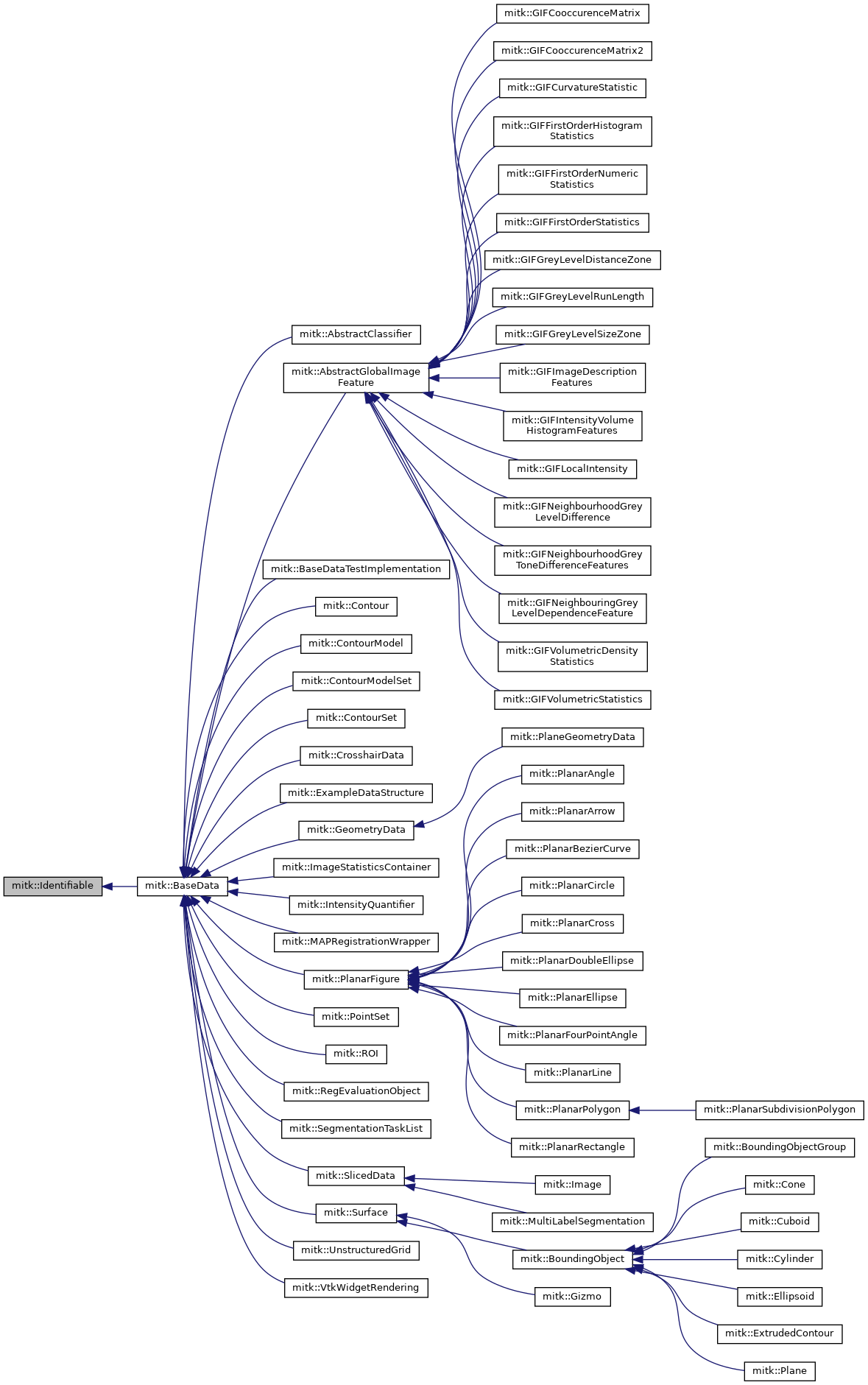
Public Types | |
| using | UIDType = std::string |
| Type alias for unique identifiers. More... | |
Public Member Functions | |
| Identifiable () | |
| Default constructor. Generates a new random UID. More... | |
| Identifiable (const UIDType &uid) | |
| Construct with a pre-existing UID. More... | |
| Identifiable (const Identifiable &)=delete | |
| Copy construction is deleted to prevent UID duplication. More... | |
| Identifiable (Identifiable &&) noexcept | |
| Move constructor. Transfers ownership of the UID. More... | |
| virtual | ~Identifiable () |
| Virtual destructor. More... | |
| Identifiable & | operator= (const Identifiable &)=delete |
| Copy assignment is deleted to prevent UID duplication. More... | |
| Identifiable & | operator= (Identifiable &&other) noexcept |
| Move assignment operator. Transfers ownership of the UID. More... | |
| virtual UIDType | GetUID () const |
| Get the unique identifier of this object. More... | |
| UIDType | GetRuntimeUID () const noexcept |
| Get a runtime-unique ID for this object instance. More... | |
Protected Member Functions | |
| virtual void | SetUID (const UIDType &uid) |
Detailed Description
Base class of identifiable objects.
Provides a universally unique identifier (UID) for each instance. Other classes can inherit from Identifiable to gain this capability.
The UID is unique at creation time but is not content-dependent:
- An instance may change its data over its lifetime and still keep the same UID.
- If an instance is persisted and loaded multiple times, several in-memory objects may share the same UID.
- UIDs are analogous to git paths (identifying an entity whose state may change) rather than git hashes. They abstract from memory addresses, enabling serialization.
- It is up to the application to ensure appropriate UID usage within its scope.
- Note
- Identifiable itself is not inherently persistable. Derived classes decide if and how to persist their UID.
- To change the UID after construction, use mitk::UIDManipulator. This indirection exists to discourage casual UID modification; it is intended for data readers only.
- See also
- UIDGenerator, UIDManipulator
Definition at line 45 of file mitkIdentifiable.h.
Member Typedef Documentation
◆ UIDType
| using mitk::Identifiable::UIDType = std::string |
Type alias for unique identifiers.
Definition at line 48 of file mitkIdentifiable.h.
Constructor & Destructor Documentation
◆ Identifiable() [1/4]
| mitk::Identifiable::Identifiable | ( | ) |
Default constructor. Generates a new random UID.
◆ Identifiable() [2/4]
|
explicit |
Construct with a pre-existing UID.
- Parameters
-
[in] uid The unique identifier to assign.
◆ Identifiable() [3/4]
|
delete |
Copy construction is deleted to prevent UID duplication.
◆ Identifiable() [4/4]
|
noexcept |
Move constructor. Transfers ownership of the UID.
◆ ~Identifiable()
|
virtual |
Virtual destructor.
Member Function Documentation
◆ GetRuntimeUID()
|
noexcept |
Get a runtime-unique ID for this object instance.
Unlike GetUID(), this ID is never persisted and never manipulated by readers. It is guaranteed unique for every distinct in-memory instance, derived from the object's memory address at construction time.
Thread-safe: written once in the constructor, read-only thereafter.
- Note
- Do not rely on this value after a move operation – the moved-to object inherits the original address.
- Returns
- A string representation of the construction-time memory address.
◆ GetUID()
|
virtual |
Get the unique identifier of this object.
- Returns
- The UID string. May be empty if the object has no UID.
Reimplemented in mitk::MAPRegistrationWrapper.
◆ operator=() [1/2]
|
delete |
Copy assignment is deleted to prevent UID duplication.
◆ operator=() [2/2]
|
noexcept |
Move assignment operator. Transfers ownership of the UID.
- Parameters
-
[in] other The source object (left in a valid but unspecified state).
- Returns
- Reference to this object.
◆ SetUID()
|
protectedvirtual |
Reimplemented in mitk::MAPRegistrationWrapper.
The documentation for this class was generated from the following file: