#include <mitkGIFGreyLevelDistanceZone.h>
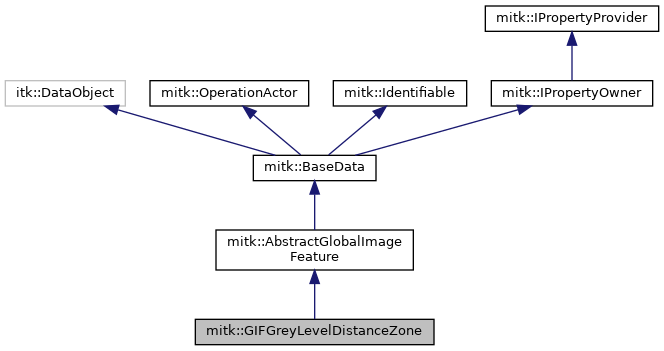
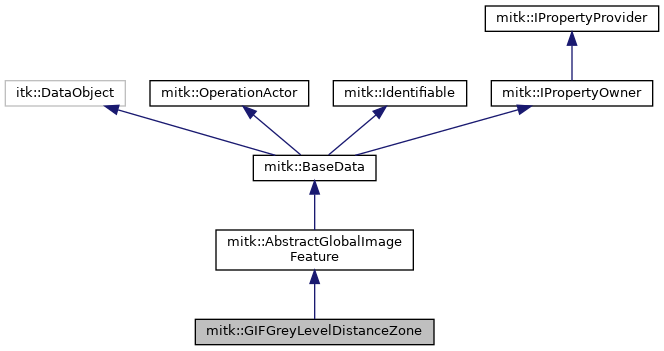
Public Member Functions | |
| mitkClassMacro (GIFGreyLevelDistanceZone, AbstractGlobalImageFeature) | |
| Calculates the Grey Level Distance Zone. More... | |
| Pointer | Clone () const |
| GIFGreyLevelDistanceZone () | |
| FeatureListType | CalculateFeatures (const Image *image, const Image *mask, const Image *maskNoNAN) override |
| Calculate grey level distance zone features for the given image and mask. More... | |
| void | AddArguments (mitkCommandLineParser &parser) const override |
| Add command line arguments for configuring this feature class. More... | |
 Public Member Functions inherited from mitk::AbstractGlobalImageFeature Public Member Functions inherited from mitk::AbstractGlobalImageFeature | |
| mitkClassMacro (AbstractGlobalImageFeature, BaseData) | |
| FeatureListType | CalculateFeatures (const Image *image, const Image *mask) |
| Calculates the feature of this abstract interface. Does not necessarily considers the parameter settings. More... | |
| FeatureListType | CalculateFeaturesSlicewise (const Image::Pointer &image, const Image::Pointer &mask, int sliceID) |
| Calculates the given feature Slice-wise. Might not be available for an individual filter! More... | |
| virtual void | CalculateAndAppendFeaturesSliceWise (const Image::Pointer &image, const Image::Pointer &mask, int sliceID, FeatureListType &featureList, bool checkParameterActivation=true) |
| Calculates the feature of this abstract interface. Does not necessarily considers the parameter settings. More... | |
| void | CalculateAndAppendFeatures (const Image *image, const Image *mask, const Image *maskNoNaN, FeatureListType &featureList, bool checkParameterActivation=true) |
| Calculates the feature of this abstract interface. Does not necessarily considers the parameter settings. More... | |
| virtual void | SetPrefix (std::string _arg) |
| Set the prefix prepended to command line option names. More... | |
| virtual void | SetShortName (std::string _arg) |
| Set the short name used in option keys and feature names. More... | |
| virtual void | SetLongName (std::string _arg) |
| Set the long (human-readable) name of this feature class. More... | |
| virtual void | SetFeatureClassName (std::string _arg) |
| Set the feature class name used in FeatureID. More... | |
| virtual void | SetDirection (int _arg) |
| Set the direction index for directional feature computation. More... | |
| void | SetParameters (ParametersType param) |
| Set the parameter map and reconfigure the instance accordingly. More... | |
| virtual std::string | GetPrefix () const |
| Get the command line option prefix. More... | |
| virtual std::string | GetShortName () const |
| Get the short name of this feature class. More... | |
| virtual std::string | GetLongName () const |
| Get the long name of this feature class. More... | |
| virtual std::string | GetFeatureClassName () const |
| Get the feature class name. More... | |
| virtual ParametersType | GetParameters () const |
| Get the current parameter map. More... | |
| virtual IntensityQuantifier::Pointer | GetQuantifier () |
| Get the IntensityQuantifier used for histogram-based feature computation. More... | |
| virtual int | GetDirection () const |
| Get the direction index. More... | |
| virtual void | SetMinimumIntensity (double _arg) |
| Set the minimum intensity for histogram initialization. More... | |
| virtual void | SetUseMinimumIntensity (bool _arg) |
| Set whether to use the explicit minimum intensity. More... | |
| virtual void | SetMaximumIntensity (double _arg) |
| Set the maximum intensity for histogram initialization. More... | |
| virtual void | SetUseMaximumIntensity (bool _arg) |
| Set whether to use the explicit maximum intensity. More... | |
| virtual double | GetMinimumIntensity () const |
| Get the minimum intensity for histogram initialization. More... | |
| virtual bool | GetUseMinimumIntensity () const |
| Get whether the explicit minimum intensity is used. More... | |
| virtual double | GetMaximumIntensity () const |
| Get the maximum intensity for histogram initialization. More... | |
| virtual bool | GetUseMaximumIntensity () const |
| Get whether the explicit maximum intensity is used. More... | |
| virtual void | SetBinsize (double _arg) |
| Set the histogram bin size. More... | |
| virtual void | SetUseBinsize (bool _arg) |
| Set whether to use the explicit bin size for histogram initialization. More... | |
| virtual double | GetBinsize () const |
| Get the histogram bin size. More... | |
| virtual bool | GetUseBinsize () const |
| Get whether the explicit bin size is used. More... | |
| virtual void | SetMorphMask (mitk::Image::Pointer _arg) |
| Set the morphological mask image used by some feature classes. More... | |
| virtual mitk::Image::Pointer | GetMorphMask () const |
| Get the morphological mask image. More... | |
| virtual void | SetBins (int _arg) |
| Set the number of histogram bins. More... | |
| virtual void | SetUseBins (bool _arg) |
| Set whether to use the explicit bin count for histogram initialization. More... | |
| virtual bool | GetUseBins () const |
| Get whether the explicit bin count is used. More... | |
| virtual int | GetBins () const |
| Get the number of histogram bins. More... | |
| virtual void | SetIgnoreMask (bool _arg) |
| Set whether to ignore the mask when computing histogram ranges. More... | |
| virtual bool | GetIgnoreMask () const |
| Get whether the mask is ignored for histogram range computation. More... | |
| virtual void | SetEncodeParametersInFeaturePrefix (bool _arg) |
| Set whether to encode parameter values in the feature name prefix. More... | |
| virtual bool | GetEncodeParametersInFeaturePrefix () const |
| Get whether parameter values are encoded in the feature name prefix. More... | |
| virtual void | EncodeParametersInFeaturePrefixOn () |
| Toggle encoding of parameter values in the feature name prefix. More... | |
| virtual void | EncodeParametersInFeaturePrefixOff () |
| std::string | GetOptionPrefix () const |
| Build the full option prefix string for command line parameters. More... | |
| void | SetRequestedRegionToLargestPossibleRegion () override |
| Set the RequestedRegion to the LargestPossibleRegion. More... | |
| bool | RequestedRegionIsOutsideOfTheBufferedRegion () override |
| Determine whether the RequestedRegion is outside of the BufferedRegion. More... | |
| bool | VerifyRequestedRegion () override |
| Verify that the RequestedRegion is within the LargestPossibleRegion. More... | |
| void | SetRequestedRegion (const itk::DataObject *) override |
| Set the requested region from this data object to match the requested region of the data object passed in as a parameter. More... | |
| bool | IsEmpty () const override |
| Check whether the object contains data at any time step. More... | |
| Public Member Functions inherited from mitk::BaseData | |
| mitkClassMacroItkParent (BaseData, itk::DataObject) | |
| BaseProperty::ConstPointer | GetConstProperty (const std::string &propertyKey, const std::string &contextName="", bool fallBackOnDefaultContext=true) const override |
| Get a const property by its key. More... | |
| std::vector< std::string > | GetPropertyKeys (const std::string &contextName="", bool includeDefaultContext=false) const override |
| Get all property keys stored in the property list. More... | |
| std::vector< std::string > | GetPropertyContextNames () const override |
| Get the names of all property contexts. More... | |
| BaseProperty * | GetNonConstProperty (const std::string &propertyKey, const std::string &contextName="", bool fallBackOnDefaultContext=true) override |
| Get a non-const property by its key. More... | |
| void | SetProperty (const std::string &propertyKey, BaseProperty *property, const std::string &contextName="", bool fallBackOnDefaultContext=false) override |
| Set a property in the property list. More... | |
| void | RemoveProperty (const std::string &propertyKey, const std::string &contextName="", bool fallBackOnDefaultContext=false) override |
| Remove a property from the property list. More... | |
| const mitk::TimeGeometry * | GetTimeGeometry () const |
| Return the TimeGeometry of the data as const pointer. More... | |
| mitk::TimeGeometry * | GetTimeGeometry () |
| Return the TimeGeometry of the data as non-const pointer. More... | |
| const mitk::TimeGeometry * | GetUpdatedTimeGeometry () |
| Return the TimeGeometry of the data after ensuring it is up-to-date. More... | |
| virtual void | Expand (unsigned int timeSteps) |
| Expand the TimeGeometry to a number of time steps. More... | |
| const mitk::BaseGeometry * | GetUpdatedGeometry (int t=0) |
| Return the BaseGeometry of the data at time step t after ensuring it is up-to-date. More... | |
| mitk::BaseGeometry * | GetGeometry (int t=0) const |
| Return the BaseGeometry of the data at time step t as a non-const pointer. More... | |
| void | UpdateOutputInformation () override |
| Update the information for this BaseData so that it can be used as an output of a BaseProcess. More... | |
| void | CopyInformation (const itk::DataObject *data) override |
| Copy information from the specified data set. More... | |
| virtual bool | IsInitialized () const |
| Check whether the data has been initialized. More... | |
| virtual void | Clear () |
| Reset the data object by calling ClearData() and InitializeEmpty(). More... | |
| virtual bool | IsEmptyTimeStep (unsigned int t) const |
| Check whether the object contains data at the specified time step. More... | |
| void | ExecuteOperation (Operation *operation) override |
| Execute an operation on this data object. More... | |
| virtual void | SetGeometry (BaseGeometry *aGeometry3D) |
| Set the BaseGeometry of the data, which will be referenced (not copied!). More... | |
| virtual void | SetTimeGeometry (TimeGeometry *geometry) |
| Set the TimeGeometry of the data, which will be referenced (not copied!). More... | |
| virtual void | SetClonedGeometry (const BaseGeometry *aGeometry3D) |
| Set a clone of the provided geometry as the BaseGeometry of the data. More... | |
| virtual void | SetClonedTimeGeometry (const TimeGeometry *geometry) |
| Set a clone of the provided TimeGeometry as the TimeGeometry of the data. More... | |
| virtual void | SetClonedGeometry (const BaseGeometry *aGeometry3D, unsigned int time) |
| Set a clone of the provided geometry as the BaseGeometry of a given time step. More... | |
| mitk::PropertyList::Pointer | GetPropertyList () const |
| Get the data's property list. More... | |
| void | SetPropertyList (PropertyList *propertyList) |
| Set the data's property list, replacing the existing one. More... | |
| mitk::BaseProperty::Pointer | GetProperty (const char *propertyKey) const |
| Get a property by its key from the PropertyList. More... | |
| void | SetProperty (const char *propertyKey, BaseProperty *property) |
| Set a property in the PropertyList. More... | |
| virtual void | SetOrigin (const Point3D &origin) |
| Convenience method for setting the origin of the BaseGeometry instances of all time steps. More... | |
| itk::SmartPointer< mitk::BaseDataSource > | GetSource () const |
| Get the process object that generated this data object. More... | |
| unsigned int | GetTimeSteps () const |
| Get the number of time steps from the TimeGeometry. More... | |
| itk::ModifiedTimeType | GetMTime () const override |
| Get the modification time of this data object or its geometry, whichever was modified most recently. More... | |
| void | Graft (const DataObject *) override |
| Graft data and information from another data object. More... | |
| Public Member Functions inherited from mitk::OperationActor | |
| itkTypeMacroNoParent (OperationActor) virtual ~OperationActor() | |
| Public Member Functions inherited from mitk::Identifiable | |
| Identifiable () | |
| Default constructor. Generates a new random UID. More... | |
| Identifiable (const UIDType &uid) | |
| Construct with a pre-existing UID. More... | |
| Identifiable (const Identifiable &)=delete | |
| Copy construction is deleted to prevent UID duplication. More... | |
| Identifiable (Identifiable &&) noexcept | |
| Move constructor. Transfers ownership of the UID. More... | |
| virtual | ~Identifiable () |
| Virtual destructor. More... | |
| Identifiable & | operator= (const Identifiable &)=delete |
| Copy assignment is deleted to prevent UID duplication. More... | |
| Identifiable & | operator= (Identifiable &&other) noexcept |
| Move assignment operator. Transfers ownership of the UID. More... | |
| virtual UIDType | GetUID () const |
| Get the unique identifier of this object. More... | |
| UIDType | GetRuntimeUID () const noexcept |
| Get a runtime-unique ID for this object instance. More... | |
| Public Member Functions inherited from mitk::IPropertyOwner | |
| ~IPropertyOwner () override | |
| virtual bool | PropertyIsOwned (const std::string &propertyKey, const std::string &contextName="", bool fallBackOnDefaultContext=true) const |
| Checks if a certain property exists. More... | |
| Public Member Functions inherited from mitk::IPropertyProvider | |
| virtual | ~IPropertyProvider () |
| Virtual destructor. More... | |
Static Public Member Functions | |
| static Pointer | New () |
| Static Public Member Functions inherited from mitk::AbstractGlobalImageFeature | |
| static std::string | GenerateLegacyFeatureNameWOEncoding (const FeatureID &id) |
Protected Member Functions | |
| FeatureListType | DoCalculateFeatures (const Image *image, const Image *mask) override |
| Protected Member Functions inherited from mitk::AbstractGlobalImageFeature | |
| std::vector< double > | SplitDouble (std::string str, char delimiter) |
| void | AddQuantifierArguments (mitkCommandLineParser &parser) const |
| void | ConfigureQuantifierSettingsByParameters () |
| virtual void | ConfigureSettingsByParameters (const ParametersType ¶meters) |
| void | InitializeQuantifier (const Image *image, const Image *mask, unsigned int defaultBins=256) |
| std::string | QuantifierParameterString () const |
| FeatureID | CreateTemplateFeatureID (std::string settingsSuffix="", FeatureID::ParametersType additionalParams={}) |
| virtual std::string | GenerateLegacyFeatureName (const FeatureID &id) const |
| virtual std::string | GenerateLegacyFeatureNamePart (const FeatureID &id) const |
| virtual std::string | GenerateLegacyFeatureEncoding (const FeatureID &id) const |
| Protected Member Functions inherited from mitk::BaseData | |
| BaseData () | |
| BaseData (const BaseData &other) | |
| ~BaseData () override | |
| virtual void | InitializeTimeGeometry (unsigned int timeSteps=1) |
| Initialize the TimeGeometry for a number of time steps. The TimeGeometry is initialized empty and evenly timed. In many cases it will be necessary to overwrite this in sub-classes. More... | |
| virtual void | ClearData () |
| reset to non-initialized state, release memory More... | |
| virtual void | InitializeEmpty () |
| Pure virtual; Must be used in subclasses to get a data object to a valid state. Should at least create one empty object and call Superclass::InitializeTimeGeometry() to ensure an existing valid geometry. More... | |
| void | PrintSelf (std::ostream &os, itk::Indent indent) const override |
| Protected Member Functions inherited from mitk::Identifiable | |
| virtual void | SetUID (const UIDType &uid) |
Additional Inherited Members | |
| Public Types inherited from mitk::AbstractGlobalImageFeature | |
| typedef std::vector< std::pair< FeatureID, double > > | FeatureListType |
| using | ParametersType = FeatureID::ParametersType |
| Public Types inherited from mitk::Identifiable | |
| using | UIDType = std::string |
| Type alias for unique identifiers. More... | |
| Protected Attributes inherited from mitk::BaseData | |
| bool | m_LastRequestedRegionWasOutsideOfTheBufferedRegion |
| unsigned int | m_SourceOutputIndexDuplicate |
| bool | m_Initialized |
Detailed Description
Definition at line 75 of file mitkGIFGreyLevelDistanceZone.h.
Constructor & Destructor Documentation
◆ GIFGreyLevelDistanceZone()
| mitk::GIFGreyLevelDistanceZone::GIFGreyLevelDistanceZone | ( | ) |
Member Function Documentation
◆ AddArguments()
|
overridevirtual |
Add command line arguments for configuring this feature class.
- Parameters
-
[in,out] parser The command line parser to add arguments to.
Implements mitk::AbstractGlobalImageFeature.
◆ CalculateFeatures()
|
overridevirtual |
Calculate grey level distance zone features for the given image and mask.
- Parameters
-
[in] image The input intensity image. [in] mask The binary mask defining the region of interest. [in] maskNoNAN The mask with NaN voxels excluded.
- Returns
- A list of computed feature name-value pairs.
Implements mitk::AbstractGlobalImageFeature.
◆ Clone()
| Pointer mitk::GIFGreyLevelDistanceZone::Clone | ( | ) | const |
◆ DoCalculateFeatures()
|
overrideprotectedvirtual |
Implements mitk::AbstractGlobalImageFeature.
◆ mitkClassMacro()
| mitk::GIFGreyLevelDistanceZone::mitkClassMacro | ( | GIFGreyLevelDistanceZone | , |
| AbstractGlobalImageFeature | |||
| ) |
Calculates the Grey Level Distance Zone.
This class can be used to calculate Grey Level Distance Zone as presented in Thibault et al. 2014.
The basic idea behind the Grey Level Distance Zone based features is to count the connected areas with a given intensity value \(x_i\) and a given distance to the border of each segmentation \(d_i\). Several features are then calculated based on a matrix, that gives the number of occurrence for each combination of \(x_i\) and \( d_i \) as \(m_{x,d}\).
This feature calculator is activated by the option -grey-level-distance-zone or -gldz.
The connected areas are based on the binned image, the binning parameters can be set via the default parameters as described in AbstractGlobalImageFeature. It is also possible to determine the dimensionality of the neighbourhood using direction-related commands as described in AbstractGlobalImageFeature. No other options are possible beside these two options.
The features are calculated based on a mask. It is assumed that the mask is of the type of an unsigned short image. It is expected that the image contains only voxels with value 0 and 1, of which all voxels with an value equal to one are treated as masked.
The features depend on the distance to the border of the segmentation ROI. In some cases, the border definition might be different from the definition of the masked area, for example, if small openings in the mask should not influence the distance. Due to that, it is possible to submit a second mask, named Morphological Mask to the features that is then used to calculate the distance of each voxel to border of the segmented area. The morpological mask can be either set by the function call SetMorphMask() or by the corresponding global option. (Not parsed by the filter itself, but by the command line tool).
Beside the complete matrix, which is represented by its individual elements \(m_{x,d}\), som eadditional values are used for the definition. \(N_g\) is the number of discrete grey levels, \( N_d\) the number (or maximum value) of possible distances, and \(N_s\) the total number of zones. \(m_{x,d}\) gives the number of connected areas with the discrete grey level x and distance to the boarder of d. Corresponding, \(p_{x,d} = \frac{m_{x,d}}{N_s} gives the relativ probability of this matrix cell. \) \(N_v\) is the number of voxels. In addition, the marginal sums \(m_{x,\cdot} = m_x = \sum_d m_{x,d} \) , representing the sum of all zones with a given intensity, and sums \(m_{\cdot, d} = m_d = \sum_x m_{x,d} \) , representing the sum of all zones with a given distance, are used. The distance are given as the number of voxels to the border and the voxel intensity is given as the bin number of the binned image, starting with 1.
The following features are then defined:
- Grey Level Distance Zone::Small Distance Emphasis:
\[ \textup{Small Distance Emphasis}= \frac{1}{N_s} \sum_d \frac{m_d}{d^2} \]
- Grey Level Distance Zone::Large Distance Emphasis:
\[ \textup{Large Distance Emphasis}= \frac{1}{N_s} \sum_d d^2 m_d \]
- Grey Level Distance Zone::Low Grey Level Emphasis:
\[ \textup{Low Grey Level Emphasis}= \frac{1}{N_s} \sum_x \frac{m_x}{x^2} \]
- Grey Level Distance Zone::High Grey Level Emphasis:
\[ \textup{High Grey Level Emphasis}= \frac{1}{N_s} \sum_x x^2 m_x \]
- Grey Level Distance Zone::Small Distance Low Grey Level Emphasis:
\[ \textup{Small Distance Low Grey Level Emphasis}= \frac{1}{N_s} \sum_x \sum_d \frac{ m_{x,d}}{x^2 d^2}\]
- Grey Level Distance Zone::Small Distance High Grey Level Emphasis:
\[ \textup{Small Distance High Grey Level Emphasis}= \frac{1}{N_s} \sum_x \sum_d \frac{x^2 m_{x,d}}{d^2}\]
- Grey Level Distance Zone::Large Distance Low Grey Level Emphasis:
\[ \textup{Large Distance Low Grey Level Emphasis}= \frac{1}{N_s} \sum_x \sum_d \frac{d^2 m_{x,d}}{x^2}\]
- Grey Level Distance Zone::Large Distance High Grey Level Emphasis:
\[ \textup{Large Distance High Grey Level Emphasis}= \frac{1}{N_s} \sum_x \sum_d \x^2 d^2 m_{x,d} \]
- Grey Level Distance Zone::Grey Level Non-Uniformity:
\[ \textup{Grey Level Non-Uniformity}= \frac{1}{N_s} \sum_x m_x^2 \]
- Grey Level Distance Zone::Grey Level Non-Uniformity Normalized:
\[ \textup{Grey Level Non-Uniformity Normalized}= \frac{1}{N_s^2} \sum_x m_x^2 \]
- Grey Level Distance Zone::Zone Distance Non-Uniformity:
\[ \textup{Grey Level Non-Uniformity}= \frac{1}{N_s} \sum_d m_d^2 \]
- Grey Level Distance Zone::Zone Distance Non-Uniformity Normalized:
\[ \textup{Grey Level Non-Uniformity Normalized}= \frac{1}{N_s^2} \sum_d m_d^2 \]
- Grey Level Distance Zone::Zone Percentage: The ratio of zones to the possible zones:
\[ \textup{Zone Percentage}= \frac{N_s}{N_v} \]
- Grey Level Distance Zone::Grey Level Mean:
\[ \textup{Grey Level Mean}= \mu_x = \sum_x \sum_d x p_{x,d} \]
- Grey Level Distance Zone::Grey Level Variance:
\[ \textup{Grey Level Variance} = \sum_x \sum_d \left(x - \mu_x \right)^2 p_{x,d} \]
- Grey Level Distance Zone::Zone Distance Mean:
\[ \textup{Zone Distance Mean}= \mu_d = \sum_x \sum_d d p_{x,d} \]
- Grey Level Distance Zone::Zone Distance Variance:
\[ \textup{Zone Distance Variance} = \sum_x \sum_d \left(d - \mu_d \right)^2 p_{x,d} \]
- Grey Level Distance Zone::Zone Distance Entropy :
\[ \textup{Zone Distance Entropy} = - \sum_x \sum_d p_{x,d} \textup{log}_2 ( p_{x,d} ) \]
- Grey Level Distance Zone::Grey Level Entropy :
\[ \textup{Grey Level Entropy} = - \sum_x \sum_d p_{x,d} \textup{log}_2 ( p_{x,d} ) \]
◆ New()
|
static |
The documentation for this class was generated from the following file: