Controls the time-related properties of the time stepper, according to the given input world time geometry.
More...
#include <mitkTimeNavigationController.h>
|
| class | TimeEvent |
| | ITK event that carries the currently selected time step. More...
|
| |
|
| static Pointer | New () |
| |
| static Pointer | New () |
| |
Controls the time-related properties of the time stepper, according to the given input world time geometry.
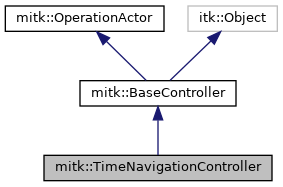
A TimeNavigationController takes a TimeGeometry as input world time geometry and sets the properties of the associated stepper (BaseController). The time-related properties are:
- steps: the number of input time steps
- pos: the current time step / position of the stepper
- range: the time bounds for the slider (minimum, maximum)
The timestep controls the selection of a specific time point from the TimeGeometry. The TimeNavigationController generates ITK events to tell observers, like a BaseRenderer, when the selected timestep changes.
Example:
timeCtrl->SetInputWorldTimeGeometry(geometry.GetPointer());
timeCtrl->Update();
Visible navigation widgets can be connected to a TimeNavigationController, e.g., a QmitkSliceNavigationWidget (for Qt):
Helper class to connect Qt-based navigators to instances of Stepper.
Definition at line 69 of file mitkTimeNavigationController.h.
◆ ObserverTagsMapType
◆ TimeNavigationController()
| mitk::TimeNavigationController::TimeNavigationController |
( |
| ) |
|
|
protected |
◆ ~TimeNavigationController()
| mitk::TimeNavigationController::~TimeNavigationController |
( |
| ) |
|
|
overrideprotected |
◆ ConnectTimeEvent()
template<typename T >
| void mitk::TimeNavigationController::ConnectTimeEvent |
( |
T * |
receiver | ) |
|
|
inline |
Connect a receiver to TimeEvent notifications.
The receiver must implement a SetGeometryTime() member function that accepts an itk::EventObject.
- Template Parameters
-
- Parameters
-
| [in] | receiver | The object to connect. Must not be nullptr. |
Definition at line 139 of file mitkTimeNavigationController.h.
◆ Disconnect()
template<typename T >
| void mitk::TimeNavigationController::Disconnect |
( |
T * |
receiver | ) |
|
|
inline |
Disconnect a receiver from TimeEvent notifications.
Removes all observer tags associated with the given receiver. If the receiver was not connected, this method does nothing.
- Template Parameters
-
- Parameters
-
| [in] | receiver | The object to disconnect. |
Definition at line 158 of file mitkTimeNavigationController.h.
◆ GetInputWorldTimeGeometry()
| virtual const mitk::TimeGeometry* mitk::TimeNavigationController::GetInputWorldTimeGeometry |
( |
| ) |
|
|
virtual |
◆ GetSelectedTimePoint()
| TimePointType mitk::TimeNavigationController::GetSelectedTimePoint |
( |
| ) |
const |
Convenience method that returns the time point that corresponds to the selected time step. The conversion is done using the time geometry of the controller. If the time geometry is not yet set, this function will always return 0.0.
◆ GetSelectedTimeStep()
| TimeStepType mitk::TimeNavigationController::GetSelectedTimeStep |
( |
| ) |
const |
Convenience method that returns the time step currently selected by the controller.
◆ mitkClassMacro()
◆ New()
| static Pointer mitk::TimeNavigationController::New |
( |
| ) |
|
|
static |
◆ SendTime()
| virtual void mitk::TimeNavigationController::SendTime |
( |
| ) |
|
|
virtual |
Send the currently selected time step to the connected observers (renderers).
Called by Update().
◆ SetInputWorldTimeGeometry()
| void mitk::TimeNavigationController::SetInputWorldTimeGeometry |
( |
const TimeGeometry * |
geometry | ) |
|
Set the input time geometry out of which the time-related properties will be generated.
Any previous set input geometry (3D or Time) will be ignored in the future.
◆ Update()
| virtual void mitk::TimeNavigationController::Update |
( |
| ) |
|
|
virtual |
Do the actual time-related properties extraction and send the currently selected time step to the connected observers (renderers).
◆ m_BlockUpdate
| bool mitk::TimeNavigationController::m_BlockUpdate |
|
protected |
◆ m_InputWorldTimeGeometry
| TimeGeometry::ConstPointer mitk::TimeNavigationController::m_InputWorldTimeGeometry |
|
protected |
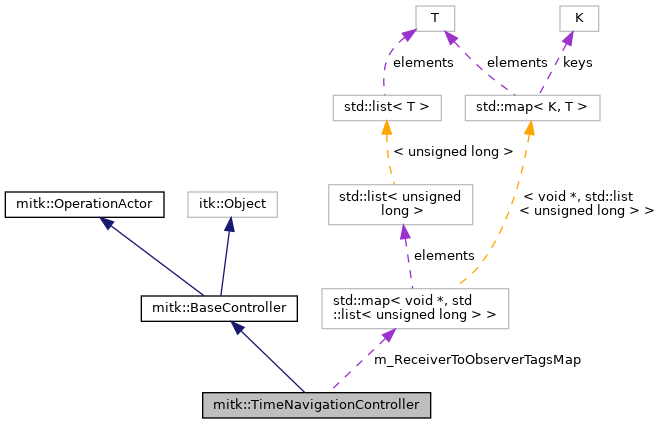
◆ m_ReceiverToObserverTagsMap
The documentation for this class was generated from the following file:
 Public Member Functions inherited from mitk::BaseController