Relation rule for ID-only relations between IIdentifiable property providers. More...
#include <mitkGenericIDRelationRule.h>
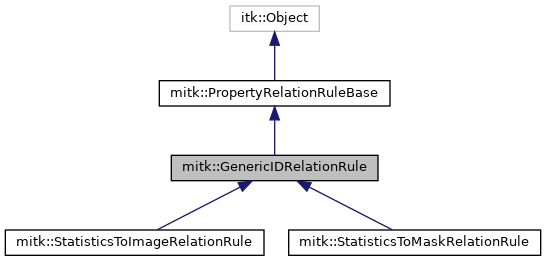
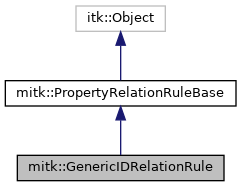
Public Types | |
| using | RuleIDType = PropertyRelationRuleBase::RuleIDType |
| using | RelationUIDType = PropertyRelationRuleBase::RelationUIDType |
| using | RelationUIDVectorType = PropertyRelationRuleBase::RelationUIDVectorType |
 Public Types inherited from mitk::PropertyRelationRuleBase Public Types inherited from mitk::PropertyRelationRuleBase | |
| enum class | RelationType { None , Data , ID , Complete } |
| using | RuleIDType = std::string |
| using | RelationUIDType = Identifiable::UIDType |
| using | RelationUIDVectorType = std::vector< RelationUIDType > |
| using | RelationVectorType = std::vector< RelationType > |
| using | InstanceIDType = std::string |
Public Member Functions | |
| mitkClassMacro (GenericIDRelationRule, PropertyRelationRuleBase) | |
| Pointer | Clone () const |
| mitkNewMacro1Param (Self, const RuleIDType &) | |
| mitkNewMacro2Param (Self, const RuleIDType &, const std::string &) | |
| mitkNewMacro4Param (Self, const RuleIDType &, const std::string &, const std::string &, const std::string &) | |
| RuleIDType | GetRuleID () const override |
| Get the rule ID string ("IDRelation_<ruleIDTag>"). More... | |
| bool | IsAbstract () const override |
| Check whether this rule instance is abstract. More... | |
| std::string | GetDisplayName () const override |
| Get a human-readable display name for the rule. More... | |
| std::string | GetSourceRoleName () const override |
| Get a human-readable description of the source role. More... | |
| std::string | GetDestinationRoleName () const override |
| Get a human-readable description of the destination role. More... | |
| RelationUIDType | Connect (IPropertyOwner *source, const IPropertyProvider *destination) const |
| Connect two property providers with an ID-based relation. More... | |
| Public Member Functions inherited from mitk::PropertyRelationRuleBase | |
| mitkClassMacroItkParent (PropertyRelationRuleBase, itk::Object) | |
| Pointer | Clone () const |
| itkCreateAnotherMacro (Self) | |
| virtual bool | IsSourceCandidate (const IPropertyProvider *owner) const |
| virtual bool | IsDestinationCandidate (const IPropertyProvider *owner) const |
| bool | IsSource (const IPropertyProvider *owner) const |
| RelationVectorType | GetRelationTypes (const IPropertyProvider *source, const IPropertyProvider *destination) const |
| bool | HasRelation (const IPropertyProvider *source, const IPropertyProvider *destination, RelationType requiredRelation=RelationType::None) const |
| RelationUIDVectorType | GetExistingRelations (const IPropertyProvider *source, RelationType layer=RelationType::None) const |
| RelationUIDVectorType | GetRelationUIDs (const IPropertyProvider *source, const IPropertyProvider *destination) const |
| RelationUIDType | GetRelationUID (const IPropertyProvider *source, const IPropertyProvider *destination) const |
| NodePredicateBase::ConstPointer | GetSourceCandidateIndicator () const |
| NodePredicateBase::ConstPointer | GetDestinationCandidateIndicator () const |
| NodePredicateBase::ConstPointer | GetConnectedSourcesDetector () const |
| NodePredicateBase::ConstPointer | GetSourcesDetector (const IPropertyProvider *destination, RelationType exclusiveRelation=RelationType::None) const |
| NodePredicateBase::ConstPointer | GetDestinationsDetector (const IPropertyProvider *source, RelationType exclusiveRelation=RelationType::None) const |
| NodePredicateBase::ConstPointer | GetDestinationDetector (const IPropertyProvider *source, RelationUIDType relationUID) const |
| void | Disconnect (IPropertyOwner *source, const IPropertyProvider *destination, RelationType layer=RelationType::Complete) const |
| void | Disconnect (IPropertyOwner *source, RelationUIDType relationUID, RelationType layer=RelationType::Complete) const |
| std::vector< PropertyKeyPath > | GetRelationPropertyPaths (const IPropertyProvider *source, RelationUIDType relationUID, RelationType layer=RelationType::Data) const |
| Get all property key paths relevant for a given relation. More... | |
Protected Types | |
| using | InstanceIDType = PropertyRelationRuleBase::InstanceIDType |
| using | InstanceIDVectorType = PropertyRelationRuleBase::InstanceIDVectorType |
| using | DataRelationUIDVectorType = PropertyRelationRuleBase::DataRelationUIDVectorType |
| Protected Types inherited from mitk::PropertyRelationRuleBase | |
| using | InstanceIDVectorType = std::vector< InstanceIDType > |
| using | DataRelationUIDVectorType = std::vector< std::pair< RelationUIDType, RuleIDType > > |
Additional Inherited Members | |
| Static Public Member Functions inherited from mitk::PropertyRelationRuleBase | |
| static PropertyKeyPath | GetRootKeyPath () |
| static PropertyKeyPath | GetRIIPropertyKeyPath (const std::string propName, const InstanceIDType &instanceID) |
| static PropertyKeyPath | GetRIIRelationUIDPropertyKeyPath (const InstanceIDType &instanceID="") |
| static PropertyKeyPath | GetRIIRuleIDPropertyKeyPath (const InstanceIDType &instanceID="") |
| static PropertyKeyPath | GetRIIDestinationUIDPropertyKeyPath (const InstanceIDType &instanceID="") |
| Static Protected Member Functions inherited from mitk::PropertyRelationRuleBase | |
| static InstanceIDType | NULL_INSTANCE_ID () |
| static InstanceIDType | GetInstanceIDByPropertyName (const std::string propName) |
| static std::vector< std::string > | GetPropertyKeys (const IPropertyProvider *owner) |
Detailed Description
Relation rule for ID-only relations between IIdentifiable property providers.
This rule class is used for relations that are defined solely on the ID-layer, with no connection on the Data-layer. It works for all ID-based relations between PropertyProviders that implement the IIdentifiable interface.
The ruleIDTag parameter, specified at construction time, serves as a suffix for the rule ID ("IDRelation_<ruleIDTag>") and allows creating distinguishable rule instances. When ruleIDTag is empty, the rule is abstract and can detect any generic ID relation but cannot create new connections.
Default role names (when not specified):
- Display name: "<ruleIDTag> relation"
- Source role: "source of <ruleIDTag> relation"
- Destination role: "destination of <ruleIDTag> relation"
Definition at line 40 of file mitkGenericIDRelationRule.h.
Member Typedef Documentation
◆ DataRelationUIDVectorType
|
protected |
Definition at line 116 of file mitkGenericIDRelationRule.h.
◆ InstanceIDType
|
protected |
Definition at line 113 of file mitkGenericIDRelationRule.h.
◆ InstanceIDVectorType
|
protected |
Definition at line 114 of file mitkGenericIDRelationRule.h.
◆ RelationUIDType
Definition at line 50 of file mitkGenericIDRelationRule.h.
◆ RelationUIDVectorType
| using mitk::GenericIDRelationRule::RelationUIDVectorType = PropertyRelationRuleBase::RelationUIDVectorType |
Definition at line 51 of file mitkGenericIDRelationRule.h.
◆ RuleIDType
Definition at line 49 of file mitkGenericIDRelationRule.h.
Constructor & Destructor Documentation
◆ GenericIDRelationRule() [1/4]
|
protected |
◆ GenericIDRelationRule() [2/4]
|
protected |
◆ GenericIDRelationRule() [3/4]
|
protected |
◆ ~GenericIDRelationRule()
|
overrideprotecteddefault |
◆ GenericIDRelationRule() [4/4]
|
protected |
Member Function Documentation
◆ Clone()
| Pointer mitk::GenericIDRelationRule::Clone | ( | ) | const |
◆ Connect()
| RelationUIDType mitk::GenericIDRelationRule::Connect | ( | IPropertyOwner * | source, |
| const IPropertyProvider * | destination | ||
| ) | const |
Connect two property providers with an ID-based relation.
Creates a new relation or updates an existing one between source and destination. The destination must implement IIdentifiable.
- Parameters
-
[in,out] source The source property owner to add the relation to. [in] destination The destination property provider to relate to.
- Returns
- The UID of the created or updated relation.
- Precondition
sourcemust be a valid instance.-
destinationmust be a valid instance. - The rule must not be abstract.
◆ Connect_datalayer()
|
overrideprotectedvirtual |
Is called by Connect() to ensure that source has correctly set properties to resemble the relation on the data layer. This means that the method should set the properties that describe and encode the relation on the data layer (data-layer-specific relation properties). If the passed instance are already connected, the old settings should be overwritten. Connect() will ensure that source and destination are valid pointers.
- Parameters
-
source destination instanceID is the ID for the relation instance that should be connected. Existence of the relation instance is ensured.
- Precondition
- source must be a valid instance.
- destination must be a valid instance.
Implements mitk::PropertyRelationRuleBase.
◆ Disconnect_datalayer()
|
overrideprotectedvirtual |
This method is called by Disconnect() to remove all properties of the relation from the source that are set by Connect_datalayer().
- Remarks
- This method should remove all properties that are set for a specific relation by Connect_datalayer(...). If the relationUID is not part of the source, nothing will be changed. Disconnect() ensures that source is a valid pointer if called.
- Disconnect() ensures that source is valid and only invokes if instance exists.
Implements mitk::PropertyRelationRuleBase.
◆ GetDestinationRoleName()
|
overridevirtual |
Get a human-readable description of the destination role.
- Returns
- The destination role name string.
Implements mitk::PropertyRelationRuleBase.
◆ GetDisplayName()
|
overridevirtual |
Get a human-readable display name for the rule.
- Returns
- The display name string.
Implements mitk::PropertyRelationRuleBase.
◆ GetRelationUIDs_DataLayer()
|
overrideprotectedvirtual |
Returns the RelationUIDs of all relations that are defined by the data layer of source for this rule instance and, if defined, destination. If the passed source (and destination) instance has no relation on the data layer, an empty vector will be returned.
- Remarks
- Per definition for property relation rules only 0 or 1 instance should be found for one provider pair and concrete rule. But there might be more then one instance because either 1) the rule is abstract and supports multiple rule IDs or 2) the data layer may be ambiguous (e.g. because the destination was not specified) and therefore multiple relation instances of the rule instance could match. The implementation of this function should report all relation instances. The calling function will take care.
- Parameters
-
source destination Destination the find relations should point to. If destination is NULL any relation on the data layer for this rule and source are wanted. instances_IDLayer List of relation instances that are already defined by the ID layer. The implementation of this function should only cover relations that are not already resembled in the passed relarions_IDLayer.
- Precondition
- source must be a pointer to a valid IPropertyProvider instance.
Implements mitk::PropertyRelationRuleBase.
◆ GetRuleID()
|
overridevirtual |
Get the rule ID string ("IDRelation_<ruleIDTag>").
- Returns
- The rule ID string.
Implements mitk::PropertyRelationRuleBase.
◆ GetSourceRoleName()
|
overridevirtual |
Get a human-readable description of the source role.
- Returns
- The source role name string.
Implements mitk::PropertyRelationRuleBase.
◆ IsAbstract()
|
overridevirtual |
Check whether this rule instance is abstract.
The rule is abstract when the ruleIDTag is empty.
- Returns
trueif the ruleIDTag is empty (abstract rule),falseotherwise.
Reimplemented from mitk::PropertyRelationRuleBase.
◆ IsSupportedRuleID()
|
overrideprotectedvirtual |
Returns if the passed rule ID is supported/relevant for the rule. Either because it is the very ID of the rule (default implementation) or because it is an abstract rule which also supports the rule ID.
- Returns
- true: If the rule ID can handle the rule ID. false: the rule does not support the rule ID.
Reimplemented from mitk::PropertyRelationRuleBase.
◆ mitkClassMacro()
| mitk::GenericIDRelationRule::mitkClassMacro | ( | GenericIDRelationRule | , |
| PropertyRelationRuleBase | |||
| ) |
◆ mitkCloneMacro()
|
protected |
◆ mitkNewMacro1Param()
| mitk::GenericIDRelationRule::mitkNewMacro1Param | ( | Self | , |
| const RuleIDType & | |||
| ) |
◆ mitkNewMacro2Param()
| mitk::GenericIDRelationRule::mitkNewMacro2Param | ( | Self | , |
| const RuleIDType & | , | ||
| const std::string & | |||
| ) |
◆ mitkNewMacro4Param()
| mitk::GenericIDRelationRule::mitkNewMacro4Param | ( | Self | , |
| const RuleIDType & | , | ||
| const std::string & | , | ||
| const std::string & | , | ||
| const std::string & | |||
| ) |
The documentation for this class was generated from the following file: