#include <mitkArbitraryTimeGeometry.h>
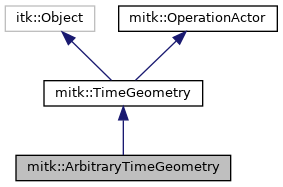

Public Types | |
| typedef ArbitraryTimeGeometry | self |
Public Member Functions | |
| mitkClassMacro (ArbitraryTimeGeometry, TimeGeometry) | |
| ArbitraryTimeGeometry () | |
| Pointer | Clone () const |
| TimeStepType | CountTimeSteps () const override |
| Returns the number of time steps. More... | |
| TimePointType | GetMinimumTimePoint () const override |
| Returns the first time point for which the time geometry instance is valid. More... | |
| TimePointType | GetMaximumTimePoint () const override |
| Returns the last time point for which the time geometry instance is valid. More... | |
| TimePointType | GetMinimumTimePoint (TimeStepType step) const override |
| Returns the first time point for which the time geometry instance is valid. More... | |
| TimePointType | GetMaximumTimePoint (TimeStepType step) const override |
| Returns the last time point for which the time geometry instance is valid. More... | |
| TimeBounds | GetTimeBounds () const override |
| Get the time bounds (in ms) it returns GetMinimumTimePoint() and GetMaximumTimePoint() results as bounds. More... | |
| TimeBounds | GetTimeBounds (TimeStepType step) const override |
| Get the time bounds for the given TimeStep (in ms) More... | |
| bool | IsValidTimePoint (TimePointType timePoint) const override |
| Tests if a given time point is covered by this time geometry instance. More... | |
| bool | IsValidTimeStep (TimeStepType timeStep) const override |
| Test for the given time step if a geometry is available. More... | |
| TimePointType | TimeStepToTimePoint (TimeStepType timeStep) const override |
| Converts a time step to a time point. More... | |
| TimeStepType | TimePointToTimeStep (TimePointType timePoint) const override |
| Converts a time point to the corresponding time step. More... | |
| BaseGeometry::Pointer | GetGeometryCloneForTimeStep (TimeStepType timeStep) const override |
| Returns the geometry which corresponds to the given time step. More... | |
| BaseGeometry::Pointer | GetGeometryForTimePoint (TimePointType timePoint) const override |
| Returns the geometry which corresponds to the given time point. More... | |
| BaseGeometry::Pointer | GetGeometryForTimeStep (TimeStepType timeStep) const override |
| Returns the geometry which corresponds to the given time step. More... | |
| bool | IsValid () const override |
| Tests if all necessary information are set and the object is valid. More... | |
| void | Initialize () override |
| Initializes a new object with one time steps which contains an empty geometry. More... | |
| void | Expand (TimeStepType size) override |
| Expands the time geometry to the given number of time steps. More... | |
| void | ReplaceTimeStepGeometries (const BaseGeometry *geometry) override |
| Replaces the geometry instances with clones of the passed geometry. More... | |
| void | SetTimeStepGeometry (BaseGeometry *geometry, TimeStepType timeStep) override |
| Sets the geometry for the given time step. More... | |
| void | ClearAllGeometries () |
| Remove all stored geometries and time bounds, leaving the container empty. More... | |
| void | AppendNewTimeStep (BaseGeometry *geometry, TimePointType minimumTimePoint, TimePointType maximumTimePoint) |
| Append a new time step with the given geometry and time bounds. More... | |
| void | AppendNewTimeStepClone (const BaseGeometry *geometry, TimePointType minimumTimePoint, TimePointType maximumTimePoint) |
| Append a new time step with a clone of the given geometry. More... | |
| void | ReserveSpaceForGeometries (TimeStepType numberOfGeometries) |
| Pre-allocate space for a given number of geometries. More... | |
| void | PrintSelf (std::ostream &os, itk::Indent indent) const override |
| bool | HasCollapsedFinalTimeStep () const |
| Check whether the final time step has collapsed (zero-duration) bounds. More... | |
 Public Member Functions inherited from mitk::TimeGeometry Public Member Functions inherited from mitk::TimeGeometry | |
| mitkClassMacroItkParent (TimeGeometry, itk::Object) | |
| Pointer | Clone () const |
| itkCreateAnotherMacro (Self) | |
| Point3D | GetCornerPointInWorld (int id) const |
| Get the position of the corner number id (in world coordinates) More... | |
| Point3D | GetCornerPointInWorld (bool xFront=true, bool yFront=true, bool zFront=true) const |
| Get the position of a corner (in world coordinates) More... | |
| Point3D | GetCenterInWorld () const |
| Get the center of the bounding-box in mm. More... | |
| double | GetDiagonalLength2InWorld () const |
| Get the squared length of the diagonal of the bounding-box in mm. More... | |
| double | GetDiagonalLengthInWorld () const |
| Get the length of the diagonal of the bounding-box in mm. More... | |
| bool | IsWorldPointInside (const mitk::Point3D &p) const |
| Test whether the point p (world coordinates in mm) is inside the bounding box. More... | |
| void | UpdateBoundingBox () |
| Recompute the bounding box to cover all time steps. More... | |
| BoundingBox * | GetBoundingBoxInWorld () const |
| Get the bounding box that covers all time steps. More... | |
| BoundingBox::BoundsArrayType | GetBoundsInWorld () const |
| Get the bounds array of the aggregate bounding box. More... | |
| ScalarType | GetExtentInWorld (unsigned int direction) const |
| Get the extent of the aggregate bounding box in the given direction. More... | |
| void | Update () |
| Update the geometry (bounding box and subclass-specific data). More... | |
| virtual void | UpdateWithoutBoundingBox () |
| Hook for subclass-specific updates that do not involve the bounding box. More... | |
| void | ExecuteOperation (Operation *op) override |
| Execute the given operation on all time steps. More... | |
| void | PrintSelf (std::ostream &os, itk::Indent indent) const override |
| Public Member Functions inherited from mitk::OperationActor | |
| itkTypeMacroNoParent (OperationActor) virtual ~OperationActor() | |
Static Public Member Functions | |
| static Pointer | New () |
Protected Member Functions | |
| ArbitraryTimeGeometry (const ArbitraryTimeGeometry &other) | |
| ~ArbitraryTimeGeometry () override | |
| mitkCloneMacro (Self) | |
| Protected Member Functions inherited from mitk::TimeGeometry | |
| TimeGeometry () | |
| TimeGeometry (const TimeGeometry &other) | |
| ~TimeGeometry () override | |
Protected Attributes | |
| std::vector< BaseGeometry::Pointer > | m_GeometryVector |
| std::vector< TimePointType > | m_MinimumTimePoints |
| std::vector< TimePointType > | m_MaximumTimePoints |
| Protected Attributes inherited from mitk::TimeGeometry | |
| BoundingBox::Pointer | m_BoundingBox |
| Contains a bounding box which includes all time steps. More... | |
Detailed Description
Definition at line 44 of file mitkArbitraryTimeGeometry.h.
Member Typedef Documentation
◆ self
Definition at line 50 of file mitkArbitraryTimeGeometry.h.
Constructor & Destructor Documentation
◆ ArbitraryTimeGeometry() [1/2]
| mitk::ArbitraryTimeGeometry::ArbitraryTimeGeometry | ( | ) |
◆ ArbitraryTimeGeometry() [2/2]
|
protected |
◆ ~ArbitraryTimeGeometry()
|
overrideprotected |
Member Function Documentation
◆ AppendNewTimeStep()
| void mitk::ArbitraryTimeGeometry::AppendNewTimeStep | ( | BaseGeometry * | geometry, |
| TimePointType | minimumTimePoint, | ||
| TimePointType | maximumTimePoint | ||
| ) |
Append a new time step with the given geometry and time bounds.
- Parameters
-
[in] geometry The geometry for the new time step. [in] minimumTimePoint Lower time bound (ms) of the new step. [in] maximumTimePoint Upper time bound (ms) of the new step.
- Precondition
- geometry must not be nullptr.
- minimumTimePoint must be >= the maximum time point of the currently last time step (no overlap).
- minimumTimePoint must be <= maximumTimePoint.
- Exceptions
-
mitk::Exception if any precondition is violated.
◆ AppendNewTimeStepClone()
| void mitk::ArbitraryTimeGeometry::AppendNewTimeStepClone | ( | const BaseGeometry * | geometry, |
| TimePointType | minimumTimePoint, | ||
| TimePointType | maximumTimePoint | ||
| ) |
Append a new time step with a clone of the given geometry.
Clones geometry and then delegates to AppendNewTimeStep().
- Parameters
-
[in] geometry The geometry to clone for the new time step. [in] minimumTimePoint Lower time bound (ms) of the new step. [in] maximumTimePoint Upper time bound (ms) of the new step.
- See also
- AppendNewTimeStep
◆ ClearAllGeometries()
| void mitk::ArbitraryTimeGeometry::ClearAllGeometries | ( | ) |
Remove all stored geometries and time bounds, leaving the container empty.
◆ Clone()
| Pointer mitk::ArbitraryTimeGeometry::Clone | ( | ) | const |
◆ CountTimeSteps()
|
overridevirtual |
Returns the number of time steps.
Returns the number of time steps for which geometries are saved. The number of time steps is also the upper bound of the time steps. The minimum time steps is always 0.
Implements mitk::TimeGeometry.
◆ Expand()
|
overridevirtual |
Expands the time geometry to the given number of time steps.
Initializes the new time steps with empty geometries. This default geometries will behave like ProportionalTimeGeometry. Shrinking is not supported. The new steps will have the same duration like the last step before extension.
Implements mitk::TimeGeometry.
◆ GetGeometryCloneForTimeStep()
|
overridevirtual |
Returns the geometry which corresponds to the given time step.
Returns a clone of the geometry which defines the given time step. If the given time step is invalid an null-pointer is returned.
Implements mitk::TimeGeometry.
◆ GetGeometryForTimePoint()
|
overridevirtual |
Returns the geometry which corresponds to the given time point.
Returns the geometry which defines the given time point. If the given time point is invalid an null-pointer is returned.
If the returned geometry is changed this will affect the saved geometry.
Implements mitk::TimeGeometry.
◆ GetGeometryForTimeStep()
|
overridevirtual |
Returns the geometry which corresponds to the given time step.
Returns the geometry which defines the given time step. If the given time step is invalid an null-pointer is returned.
If the returned geometry is changed this will affect the saved geometry.
Implements mitk::TimeGeometry.
◆ GetMaximumTimePoint() [1/2]
|
overridevirtual |
Returns the last time point for which the time geometry instance is valid.
Gives the last time point for which a valid geometry is saved in this time geometry. It is the upper time bound of the last step. The time point is given in ms.
Implements mitk::TimeGeometry.
◆ GetMaximumTimePoint() [2/2]
|
overridevirtual |
Returns the last time point for which the time geometry instance is valid.
Gives the last time point for the Geometry specified by the given TimeStep. The time point is given in ms.
Implements mitk::TimeGeometry.
◆ GetMinimumTimePoint() [1/2]
|
overridevirtual |
Returns the first time point for which the time geometry instance is valid.
Returns the first valid time point for this geometry. It is the lower time bound of the first step. The time point is given in ms.
Implements mitk::TimeGeometry.
◆ GetMinimumTimePoint() [2/2]
|
overridevirtual |
Returns the first time point for which the time geometry instance is valid.
Returns the first valid time point for the given TimeStep. The time point is given in ms.
Implements mitk::TimeGeometry.
◆ GetTimeBounds() [1/2]
|
overridevirtual |
Get the time bounds (in ms) it returns GetMinimumTimePoint() and GetMaximumTimePoint() results as bounds.
Implements mitk::TimeGeometry.
◆ GetTimeBounds() [2/2]
|
overridevirtual |
Get the time bounds for the given TimeStep (in ms)
Implements mitk::TimeGeometry.
◆ HasCollapsedFinalTimeStep()
| bool mitk::ArbitraryTimeGeometry::HasCollapsedFinalTimeStep | ( | ) | const |
Check whether the final time step has collapsed (zero-duration) bounds.
This indicates a problematic corner case that frequently occurs when loading dynamic DICOM data stored as single-frame images, where no duration can be deduced for the last time step. The minimum and maximum time bounds of the final step are identical.
- Returns
- true if the final time step has min == max time bound.
◆ Initialize()
|
overridevirtual |
Initializes a new object with one time steps which contains an empty geometry.
Reimplemented from mitk::TimeGeometry.
◆ IsValid()
|
overridevirtual |
Tests if all necessary information are set and the object is valid.
Implements mitk::TimeGeometry.
◆ IsValidTimePoint()
|
overridevirtual |
Tests if a given time point is covered by this time geometry instance.
Returns true if a geometry can be returned for the given time point (so it is within GetTimeBounds() and fails if not. The time point must be given in ms.
Implements mitk::TimeGeometry.
◆ IsValidTimeStep()
|
overridevirtual |
Test for the given time step if a geometry is available.
Returns true if a geometry is defined for the given time step. Otherwise false is returned. The time step is defined as positive number.
Implements mitk::TimeGeometry.
◆ mitkClassMacro()
| mitk::ArbitraryTimeGeometry::mitkClassMacro | ( | ArbitraryTimeGeometry | , |
| TimeGeometry | |||
| ) |
◆ mitkCloneMacro()
|
protected |
◆ New()
|
static |
◆ PrintSelf()
|
override |
◆ ReplaceTimeStepGeometries()
|
overridevirtual |
Replaces the geometry instances with clones of the passed geometry.
Replaces the geometries of all time steps with clones of the passed geometry. Replacement strategy depends on the implementation of TimeGeometry sub class.
- Remarks
- The time points itself stays untouched. Use this method if you want to change the spatial properties of a TimeGeometry and preserve the time "grid".
Implements mitk::TimeGeometry.
◆ ReserveSpaceForGeometries()
| void mitk::ArbitraryTimeGeometry::ReserveSpaceForGeometries | ( | TimeStepType | numberOfGeometries | ) |
Pre-allocate space for a given number of geometries.
Reserves memory in the internal vectors for geometries and time bounds without actually creating objects.
- Parameters
-
[in] numberOfGeometries The number of slots to reserve.
◆ SetTimeStepGeometry()
|
overridevirtual |
Sets the geometry for the given time step.
If passed time step is not valid. Nothing will be changed.
- Precondition
- geometry must point to a valid instance.
Implements mitk::TimeGeometry.
◆ TimePointToTimeStep()
|
overridevirtual |
Converts a time point to the corresponding time step.
Converts a time point to a time step in a way that the new time step indicates the same geometry as the time point. The associated time step is the last step which lower time bound is smaller or equal then the time point. If a negative invalid time point is given always time step 0 is returned. If a positive invalid time point is given the last time step will be returned. This is also true for time points that are exactly on the upper time bound (the only exception is the final time step in case that HasCollapsedFinalTimeStep() is true).
Implements mitk::TimeGeometry.
◆ TimeStepToTimePoint()
|
overridevirtual |
Converts a time step to a time point.
Converts a time step to a time point by using the time steps lower time bound. If the original time steps does not point to a valid geometry, a time point is calculated that also does not point to a valid geometry, but no exception is raised.
Implements mitk::TimeGeometry.
Member Data Documentation
◆ m_GeometryVector
|
protected |
Definition at line 277 of file mitkArbitraryTimeGeometry.h.
◆ m_MaximumTimePoints
|
protected |
Definition at line 279 of file mitkArbitraryTimeGeometry.h.
◆ m_MinimumTimePoints
|
protected |
Definition at line 278 of file mitkArbitraryTimeGeometry.h.
The documentation for this class was generated from the following file: